When most people think of eco-tourism they have images of wealthy couples exploring the Amazon or the rainforests of Borneo.
Eco-tourist company, Learn Great Foods, provides a different form of earth friendly exploration. With day and weekend tours, LGF takes guests to eco-friendly farms, retailers and communities like those found in Leland, Michigan.
About six hours drive from Chicago and nearly five from Detroit; Leland sits on the northern tip of the Leelanau peninsula on Lake Michigan. The small community is considered a great getaway in both summer and winter. In the summer the open waters provide boating, fishing and swimming. In the winter the 130-inch average snowfall provides cross-country skiing and snowmobiling opportunities for the enthusiast. Hunting and bird watching provide activity in the fall and spring respectively.
But LGF approaches the peninsula differently, instead focusing on Community Supported Agriculture and organic food providers. On a recent autumn Saturday, LGF tourists visited Sweeter Song Farms run by Judy Reinhardt and Jim Schwantes. The couple showed their guests the operation that provides member families from the area with fresh produce throughout the summer and fall.
"The last beets and carrots are about ready to come out of the ground," Judy told the visitors. "We have one more distribution before winter."
The guests were permitted to pick a basket of vegetables as they toured the acreage of this century old farm. The vegetables were turned over to a local chef, Perry Harmon, hired by LGF to prepare a gourmet meal from the ingredients the tourists would gather or purchase throughout the day.
The next stop of the day was to Leland's historic Fishtown. On the waters edge, this collection of shops and buildings appear more like an 18th century fishing village than the modern products sold inside. The first stop was to Carlson's Fish Market, a family operation for 150 years. The market sells line caught Great Lakes and ocean fish.
The tourists bought salmon, whitefish and lake trout before heading over to the Cheese Barn. The small cheese stand was having an end-of-the-season sale and the group found some wonderful organic goat cheeses for the price of commercial dairy cheese.
They visited a local winery and organic beef operation before heading back to Chef Perry. The chef prepared the meal in the Sweeter Song Farms kitchen as the group diligently took notes on how he paired food choices. The fish was pan fried and served with a pear relish with onions, peppers and some herbs grown in Judy's herb patch. For desert he prepared an apple crunch with fresh local apples.
The tour was $85 per person for the daylong event and included all the ingredients for the gourmet meal. President of LGF, Ann Dougherty, offers a variety of packages and trips. Itineraries, reservations and program descriptions are available at www.learngreatfoods.com
Friday, October 27, 2006

Thursday, October 26, 2006
Gay marriage is bad for business
With yesterday's New Jersey Supreme Court ruling ordering the state legislature to create an institution that approximates marriage for homosexuals and requiring the extension of benefits to same-sex couples and their children, the Republicans are hoping to energize conservatives to vote for GOP congressional candidates. Desperate to distract the voters from the economy and from the quagmire in Iraq, this ruling has already been touted as an example of "activist judges" and "the imperial judiciary... "impos[ing] same sex marriage in New Jersey."
For 30 years the GOP campaigned for smaller government, for state's right and against government intrusion in people's lives. Even on the fractious issue of abortion rights, the Republicans declared the necessity of letting the individual states decide. So who are these imposters in elephant clothing who want the Feds to decide to whom states can issue a marriage license, expanding government power and spending and encouraging the US Supreme Court to overturn jury awards in state courts? (See http://www.nytimes.com/2006/10/26/opinion/26thu4.html?th&emc=th)
While growing up in working class Cleveland in the 70s, political parties were defined in simple terms. The Democrats are for the little guy and the Republicans are for big business. Simple, clean and bereft of the left/right demarcations. Back then, Joe Everyman belonged to a union, worked in manufacturing or the trades, went to church or didn’t, made a decent living and thought a hot dog at the ball game was a gourmet meal. (Especially in Cleveland with Stadium Mustard.) Although he wasn’t the most tolerant of souls when it came to gays — he probably called them ‘queers’ — he frankly didn’t care enough about them to worry. He might have known a couple at work or from the neighborhood. But for the most part he never worried about their corrupting influence on society.
Joe Everyman was mistrustful of corporations — convinced after years of abuse that the company didn’t care about the workers — and would never call himself “pro-business.” At the same time, he was just as likely to subscribe to the philosophy of “Buy American.” Not because of xenophobia or racism, but rather because he understood that in a very real sense his economic interest was tied to the marketplace. He saw that an increasing number of goods were being made overseas and that companies were looking for cheaper labor. The line didn’t hold very long.
Soon the average family needed two wage earners and increasingly the good union jobs were being lost. By the mid-80s the steel mills, the shipyards, the foundries, the factories and the trades were laying off people in record numbers.
It was during this same period that the Republicans began to redefine the political parties. The Democrats became the party of tax and spend, the party of every crackpot issue, the party of liberals. The GOP became the party of rugged individualism — a party that preached, “if you’re poor it’s your fault” — the party of American strength and pride, the party of white, middle class ascendancy. It didn’t matter that these views were in opposition to reality any more than the old definitions did. Slick campaigning portrayed Democrats as weaklings, lackeys of big government waste.
People started to question why so many “minorities” received welfare — remember the welfare queens in their mink coats and Cadillacs (hey at least they bought American) — even though statistics showed that the overwhelming number of folks on the welfare rolls were white. The fundamental shift is best seen in the support for the White House’s union busting in the air-traffic controllers strike. Workers who favored unions were seen as obstructionists and crybabies. Stories were legion about the difficulty of getting union employees to follow even the simplest rules and firing someone was described as impossible.
What people failed to see was that supporting this reasoning, following this thinking enriched corporations but not the people. Supporting the GOP was patriotic even if the party routinely voted against middle and working class interests. To point this out, one risked the label of liberal and worse — some suggesting that to support such a position only empowered our enemies (the evil Soviets and their allies).
Each year, as real wages for the bottom two-thirds of Americans stagnated or fell, as corporate profits soared and the term “golden parachute” joined the common lexicon, the GOP became more powerful. The Republicans somehow created a dichotomy between conservative and liberal and assigned itself the former. The party further defined anything liberal as anti-American, anti-God and to blame for all the world’s ills.
Each election cycle the GOP found issues to divide the opposition into splinter groups. Minority v. white “Americanism”, urban “corruption” v. rural “heartland”, educated “elite” v. “real.” In essence these dualities always favored the rich and fractured the rest of us. The power in urban areas didn’t lie with the poor people who lived there, but rather with the suburban “carpet-baggers” who controlled employment. The educated elite were rarely in favor of an egalitarian state, rather they were enriching themselves from running the United States. The poor were painted as non-whites in spite of the numbers to the contrary.
Now it’s a liberal assault on religion and marriage that the GOP uses to frame the issues. Forget Iraq, forget illegal immigration, forget gay marriage: these issues are straw men. Implementing policies that would benefit the economic bottom nine-tenths of America are the real issues for the GOP.
The more one considers the issues, it appears Republicans are opposed to same sex marriage not on moral or legal grounds but rather for pro-business economic reasons. If homosexual unions are recognized on a federal level, businesses would have to extend benefits to same-sex partners that they currently extend to heterosexual married partners. (Sometime during the 80s the concept of common-law marriage became extinct and all marriages needed government sanction.)
The same economic impact holds true in undocumented workers. Any recognition of rights for these people would cost employers much more money than they pay now. Undocumented workers are not entitled to workers compensation, family and medical leave, overtime pay, OSHA regulations or sick time. And if workers agitate for these things they are fired and cannot seek government redress.
The government policy in Iraq is also based in enriching the wealthy — and here it is more insidious. While corporations like Halliburton are making untold millions without paying corporate income tax, the voters foot the bill. Meanwhile, well-meaning Americans suffer needless deaths and dismemberments.
GOP policy is not directed from any moral compass; it’s based on enriching the wealthiest and dividing the rest of us.
For 30 years the GOP campaigned for smaller government, for state's right and against government intrusion in people's lives. Even on the fractious issue of abortion rights, the Republicans declared the necessity of letting the individual states decide. So who are these imposters in elephant clothing who want the Feds to decide to whom states can issue a marriage license, expanding government power and spending and encouraging the US Supreme Court to overturn jury awards in state courts? (See http://www.nytimes.com/2006/10/26/opinion/26thu4.html?th&emc=th)
While growing up in working class Cleveland in the 70s, political parties were defined in simple terms. The Democrats are for the little guy and the Republicans are for big business. Simple, clean and bereft of the left/right demarcations. Back then, Joe Everyman belonged to a union, worked in manufacturing or the trades, went to church or didn’t, made a decent living and thought a hot dog at the ball game was a gourmet meal. (Especially in Cleveland with Stadium Mustard.) Although he wasn’t the most tolerant of souls when it came to gays — he probably called them ‘queers’ — he frankly didn’t care enough about them to worry. He might have known a couple at work or from the neighborhood. But for the most part he never worried about their corrupting influence on society.
Joe Everyman was mistrustful of corporations — convinced after years of abuse that the company didn’t care about the workers — and would never call himself “pro-business.” At the same time, he was just as likely to subscribe to the philosophy of “Buy American.” Not because of xenophobia or racism, but rather because he understood that in a very real sense his economic interest was tied to the marketplace. He saw that an increasing number of goods were being made overseas and that companies were looking for cheaper labor. The line didn’t hold very long.
Soon the average family needed two wage earners and increasingly the good union jobs were being lost. By the mid-80s the steel mills, the shipyards, the foundries, the factories and the trades were laying off people in record numbers.
It was during this same period that the Republicans began to redefine the political parties. The Democrats became the party of tax and spend, the party of every crackpot issue, the party of liberals. The GOP became the party of rugged individualism — a party that preached, “if you’re poor it’s your fault” — the party of American strength and pride, the party of white, middle class ascendancy. It didn’t matter that these views were in opposition to reality any more than the old definitions did. Slick campaigning portrayed Democrats as weaklings, lackeys of big government waste.
People started to question why so many “minorities” received welfare — remember the welfare queens in their mink coats and Cadillacs (hey at least they bought American) — even though statistics showed that the overwhelming number of folks on the welfare rolls were white. The fundamental shift is best seen in the support for the White House’s union busting in the air-traffic controllers strike. Workers who favored unions were seen as obstructionists and crybabies. Stories were legion about the difficulty of getting union employees to follow even the simplest rules and firing someone was described as impossible.
What people failed to see was that supporting this reasoning, following this thinking enriched corporations but not the people. Supporting the GOP was patriotic even if the party routinely voted against middle and working class interests. To point this out, one risked the label of liberal and worse — some suggesting that to support such a position only empowered our enemies (the evil Soviets and their allies).
Each year, as real wages for the bottom two-thirds of Americans stagnated or fell, as corporate profits soared and the term “golden parachute” joined the common lexicon, the GOP became more powerful. The Republicans somehow created a dichotomy between conservative and liberal and assigned itself the former. The party further defined anything liberal as anti-American, anti-God and to blame for all the world’s ills.
Each election cycle the GOP found issues to divide the opposition into splinter groups. Minority v. white “Americanism”, urban “corruption” v. rural “heartland”, educated “elite” v. “real.” In essence these dualities always favored the rich and fractured the rest of us. The power in urban areas didn’t lie with the poor people who lived there, but rather with the suburban “carpet-baggers” who controlled employment. The educated elite were rarely in favor of an egalitarian state, rather they were enriching themselves from running the United States. The poor were painted as non-whites in spite of the numbers to the contrary.
Now it’s a liberal assault on religion and marriage that the GOP uses to frame the issues. Forget Iraq, forget illegal immigration, forget gay marriage: these issues are straw men. Implementing policies that would benefit the economic bottom nine-tenths of America are the real issues for the GOP.
The more one considers the issues, it appears Republicans are opposed to same sex marriage not on moral or legal grounds but rather for pro-business economic reasons. If homosexual unions are recognized on a federal level, businesses would have to extend benefits to same-sex partners that they currently extend to heterosexual married partners. (Sometime during the 80s the concept of common-law marriage became extinct and all marriages needed government sanction.)
The same economic impact holds true in undocumented workers. Any recognition of rights for these people would cost employers much more money than they pay now. Undocumented workers are not entitled to workers compensation, family and medical leave, overtime pay, OSHA regulations or sick time. And if workers agitate for these things they are fired and cannot seek government redress.
The government policy in Iraq is also based in enriching the wealthy — and here it is more insidious. While corporations like Halliburton are making untold millions without paying corporate income tax, the voters foot the bill. Meanwhile, well-meaning Americans suffer needless deaths and dismemberments.
GOP policy is not directed from any moral compass; it’s based on enriching the wealthiest and dividing the rest of us.
Watch this video
Click on the title above to watch commentary by MSNBCs Keith Olbermann. Amazingly spot on, please share with friends and family.
Thursday, October 19, 2006

Torturing the Constitution
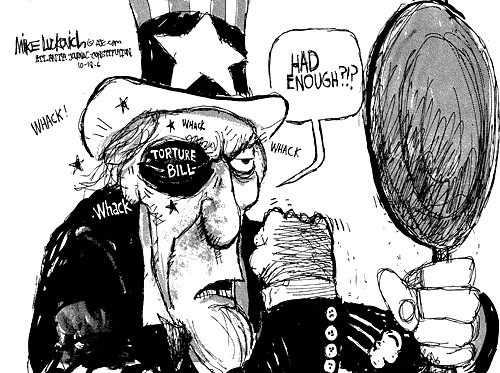
The new law signed last weekend by President Bush denying prisoners of the War on Terror rights to Habeus Corpus has already been implemented. According to the New York Times, federal officials have served notice to the courts with pending lawsuits on behalf of terror suspects to dismiss the cases for lack of jurisdiction.
According to the Times editorial, the new law "raises insurmountable obstacles for prisoners to challenge their detentions. It does not require the government to release prisoners who are not being charged, or a prisoner who is exonerated by the tribunals.
The law does not apply to American citizens, but it does apply to other legal United States residents. And it chips away at the foundations of the judicial system in ways that all Americans should find threatening. It further damages the nation’s reputation and, by repudiating key protections of the Geneva Conventions, it needlessly increases the danger to any American soldier captured in battle."
Had enough yet? Don't forget to vote next month.
Thursday, October 12, 2006
Support our troops unless they do their jobs
US Navy Lt. Commander Charles Swift — the JAG lawyer for Salim Hamdan who was told to "negotiate a guilty plea" and instead acted ethically on behalf of his client — was passed over for promotion and will soon be separated from the service.
Meanwhile the president is being permitted to continue kidnap and torture alleged enemies of the United States. In fact his powers have actually been extended to include not just those who actually take up arms or plan violence US, he can also kidnap and torture those who support terrorists in any way. (The administration announced today that they had arrested some nut job in California who called for the overthrow of the American government.)
Ethical behavior is punished while sadistic behavior appears to be protected. Bush should grow himself a little mustache.
Meanwhile the president is being permitted to continue kidnap and torture alleged enemies of the United States. In fact his powers have actually been extended to include not just those who actually take up arms or plan violence US, he can also kidnap and torture those who support terrorists in any way. (The administration announced today that they had arrested some nut job in California who called for the overthrow of the American government.)
Ethical behavior is punished while sadistic behavior appears to be protected. Bush should grow himself a little mustache.
Thursday, September 28, 2006
Power and politics
If the legislation President Bush demanded passes as it is now worded, the Bill of Rights will be invalidated.
The legislation defines an enemy combatant as anyone "engaged in hostilities or who has purposefully and materially supported hostilities against the United States." How many times has this administration argued that dissent helps the terrorists? How often has the administration said, "you're either with us or against us?"
To suggest that this legislation is anything but a usurpation of the Constitution is absurd. How much more damage will this administration do?
Every time this administration attempts to expand its power the terrorists gain a victory. And one suspects that the real reason for pushing this through without reasoned debate is politically motivated. The Republicans risk losing control of one or both houses of Congress and need a way to attack the Democrats. Saying Democrats are weak on terrorism and using "no" votes on this legislation as proof, will be the rallying cry for Republicans in the coming weeks.
Sen. Arlen Specter, R-Penn., was a lone Republican voice opposing the President and is now being assailed all over talk radio. If it weren't for the Colorado hostage incident yesterday, he'd be all over the TV too.
The Republicans want us to be scared so they can keep power.
The legislation defines an enemy combatant as anyone "engaged in hostilities or who has purposefully and materially supported hostilities against the United States." How many times has this administration argued that dissent helps the terrorists? How often has the administration said, "you're either with us or against us?"
To suggest that this legislation is anything but a usurpation of the Constitution is absurd. How much more damage will this administration do?
Every time this administration attempts to expand its power the terrorists gain a victory. And one suspects that the real reason for pushing this through without reasoned debate is politically motivated. The Republicans risk losing control of one or both houses of Congress and need a way to attack the Democrats. Saying Democrats are weak on terrorism and using "no" votes on this legislation as proof, will be the rallying cry for Republicans in the coming weeks.
Sen. Arlen Specter, R-Penn., was a lone Republican voice opposing the President and is now being assailed all over talk radio. If it weren't for the Colorado hostage incident yesterday, he'd be all over the TV too.
The Republicans want us to be scared so they can keep power.
Wednesday, September 27, 2006
Don't insult the President.
The 7-Eleven convenient store chain announced today that it was dropping Citgo as its fuel provider because Venezuelan President Hugo Chavez called President George W. Bush "the devil."
Americans, it seems, are outraged that a foreign leader would use insulting rhetoric about the president. There are calls for boycotts of all things Venezuelan. There are even some who are calling for Noam Chomsky's head because Chavez told folks to read "Hegemony or Survival: America's Quest for Global Dominance." Fox News referred to Chomsky as an "American leftist writer." The news outlet was particularly shrill in its criticism of Chavez and the United Nations.
I've never fully understood the right's desire to kill the U.N., but they point to last week's speeches by Chavez and Iranian President Mahmoud Ahmadinejad as reasons to end the international institution.
They have the right to their opinions and their boycotts. But the irony here is that after the 2001 attacks in New York and DC, no one on the right called for a boycott of Saudi oil.
The message, I guess, is that it's OK to kill Americans just don't insult the president. That we won't stand for.
Americans, it seems, are outraged that a foreign leader would use insulting rhetoric about the president. There are calls for boycotts of all things Venezuelan. There are even some who are calling for Noam Chomsky's head because Chavez told folks to read "Hegemony or Survival: America's Quest for Global Dominance." Fox News referred to Chomsky as an "American leftist writer." The news outlet was particularly shrill in its criticism of Chavez and the United Nations.
I've never fully understood the right's desire to kill the U.N., but they point to last week's speeches by Chavez and Iranian President Mahmoud Ahmadinejad as reasons to end the international institution.
They have the right to their opinions and their boycotts. But the irony here is that after the 2001 attacks in New York and DC, no one on the right called for a boycott of Saudi oil.
The message, I guess, is that it's OK to kill Americans just don't insult the president. That we won't stand for.
Tuesday, September 26, 2006
When do we get the swastikas?
Now that we have a president who openly admits to secret US prisons and torture, a president who believes in kidnapping and a blanket threat posed by an entire group of people, I wonder what possibly could be next on his agenda.
I am often tempted to write screeds here, shouting about the Nazification (hey the other side can make up words, why can't I?) of America. It's difficult to believe so passionately in the possibility of this country all the while watching as it is destroyed from within. When will sanity return?
Democrats are impotent, the news media is ignorant and the populace isn't interested. There is no public outcry about the erosion of the Constitution. There is no real public debate about the use of torture on "enemy combatants." Where is the "Greatest Generation," the ones who won World War II? Where are the ones who said "Never Again?"
The great irony of our time is that the right uses imagery and mimicry of that time to bamboozle the people. Don't like what the left is saying; accuse them of using Nazi propaganda techniques. [www.politicalgateway.com/main/columns/read.html?col=89]
Don't like the growing anti-war sentiment, accuse them of appeasing Hitler. [http://www.latimes.com/news/nationworld/nation/la-na-legion30aug30,0,7356486.story?coll=la-home-headlines]
Don't like journalists poking around, accuse them of ties to terrorists and arrest them, shooting him first if need be. [http://sirhumphreys.blogspot.com/2005/10/ap-and-reuters-photographer-bilal.html and at http://www.iht.com/articles/2005/09/15/news/cbs.php]
When it becomes hard to discern the truth from the lies people stop listening. Soon we will have national identification cards. When do we get the swastikas?
I am often tempted to write screeds here, shouting about the Nazification (hey the other side can make up words, why can't I?) of America. It's difficult to believe so passionately in the possibility of this country all the while watching as it is destroyed from within. When will sanity return?
Democrats are impotent, the news media is ignorant and the populace isn't interested. There is no public outcry about the erosion of the Constitution. There is no real public debate about the use of torture on "enemy combatants." Where is the "Greatest Generation," the ones who won World War II? Where are the ones who said "Never Again?"
The great irony of our time is that the right uses imagery and mimicry of that time to bamboozle the people. Don't like what the left is saying; accuse them of using Nazi propaganda techniques. [www.politicalgateway.com/main/columns/read.html?col=89]
Don't like the growing anti-war sentiment, accuse them of appeasing Hitler. [http://www.latimes.com/news/nationworld/nation/la-na-legion30aug30,0,7356486.story?coll=la-home-headlines]
Don't like journalists poking around, accuse them of ties to terrorists and arrest them, shooting him first if need be. [http://sirhumphreys.blogspot.com/2005/10/ap-and-reuters-photographer-bilal.html and at http://www.iht.com/articles/2005/09/15/news/cbs.php]
When it becomes hard to discern the truth from the lies people stop listening. Soon we will have national identification cards. When do we get the swastikas?
Friday, September 15, 2006
Why isn't everyone bothered?
When President Bush took his case to Congress and the nation that extraordinary measures were needed in both the investigation and prosecution of terror suspects the lack of outrage was deafening.
He spoke of restricting access to evidence, holding trials without the defendant present, permitting coerced testimony and third party assertions. He asked that Congress give a free pass to interrogators so they know they won't face criminal prosecution for their work.
Is this really the kind of debate the government of the United States should be having?
When Bush ran in 2000 he said he was going to "restore dignity and honor to the White House." Now he is suggesting that honor and integrity should be removed from the Code of Military Justice.
In the closing trial scene of Rob Reiner's film "A Few Good Men," Jack Nicholson's character said, "You f***in' people. You have no idea how to defend a nation. All you did was weaken a country today. That's all you did. You put people's lives in danger. Sweet dreams." He justified the killing of a Marine in his charge by saying that although tragic, the Marine's death probably saved lives. Is that the way we want to live? Is that the course that we think is best? Killing people saves lives?
But few Americans object, few of us do anything more than complain. We hear the administration shouting "Danger, danger" like the robot in "Lost in Space" and we accept it.
I understand that some people trust the government, some people believe that the war in Iraq is a pivotal part of the war on terror. I know there are people who think that anything is OK if it keeps us safe. Torture is a terrorist tactic. The threat of pain or death is what they hope to inspire.
Are we for or against terrorism? Or does nothing bother us at all?
He spoke of restricting access to evidence, holding trials without the defendant present, permitting coerced testimony and third party assertions. He asked that Congress give a free pass to interrogators so they know they won't face criminal prosecution for their work.
Is this really the kind of debate the government of the United States should be having?
When Bush ran in 2000 he said he was going to "restore dignity and honor to the White House." Now he is suggesting that honor and integrity should be removed from the Code of Military Justice.
In the closing trial scene of Rob Reiner's film "A Few Good Men," Jack Nicholson's character said, "You f***in' people. You have no idea how to defend a nation. All you did was weaken a country today. That's all you did. You put people's lives in danger. Sweet dreams." He justified the killing of a Marine in his charge by saying that although tragic, the Marine's death probably saved lives. Is that the way we want to live? Is that the course that we think is best? Killing people saves lives?
But few Americans object, few of us do anything more than complain. We hear the administration shouting "Danger, danger" like the robot in "Lost in Space" and we accept it.
I understand that some people trust the government, some people believe that the war in Iraq is a pivotal part of the war on terror. I know there are people who think that anything is OK if it keeps us safe. Torture is a terrorist tactic. The threat of pain or death is what they hope to inspire.
Are we for or against terrorism? Or does nothing bother us at all?
Tuesday, September 12, 2006
They don't mind being wrong....
There is a myth that all of corporate America will do anything to make a profit including resort to the tactics like those associated with the recent Hewlitt Packard mess, that corporations are greedy and evil. We know that most corporations are responsible citizens who would do nothing to hurt people.
We also know of crazy lawsuits with huge settlements that make things tough for business. That's why fast food restaurants need to warn that the coffee is hot. That's why ice skating rinks need to warn us that ice is slippery. That's why doctors can't afford malpractice insurance.
But really we don't know anything.
Click on the title of this entry to check out the Drum Major Policy Web site Tort Deform to learn more. It's a surprising read.
The fact is that insurance companies are behind the much of the call for tort reform not because they're losing so much money in lawsuits, but because they can maximize profits by limiting liabilities and increasing premiums.
Look no further than the Gulf Coast. The feds will compensate homeowners and renters who carried insurance only. If a family didn't have insurance on their house, they get nothing. Meanwhile the insurance companies are paying a pittance of what their policy holders paid for in premiums.
Corporate America doesn't mind being wrong, they just don't want to pay for it.
We also know of crazy lawsuits with huge settlements that make things tough for business. That's why fast food restaurants need to warn that the coffee is hot. That's why ice skating rinks need to warn us that ice is slippery. That's why doctors can't afford malpractice insurance.
But really we don't know anything.
Click on the title of this entry to check out the Drum Major Policy Web site Tort Deform to learn more. It's a surprising read.
The fact is that insurance companies are behind the much of the call for tort reform not because they're losing so much money in lawsuits, but because they can maximize profits by limiting liabilities and increasing premiums.
Look no further than the Gulf Coast. The feds will compensate homeowners and renters who carried insurance only. If a family didn't have insurance on their house, they get nothing. Meanwhile the insurance companies are paying a pittance of what their policy holders paid for in premiums.
Corporate America doesn't mind being wrong, they just don't want to pay for it.
Monday, September 11, 2006
The terrorists have won
Remember when Republicans demanded that Democrats not use Sept. 11 politically, that the deaths of nearly 3,000 Americans be respected? Remember when the world was outraged over the attacks and united in its goal to stop terrorism? Remember when President Bush declared that he wanted Osama bin Laden "dead or alive?"
Of course it's hard not to remember these things because on the fifth anniversary of that day, the GOP is beating the drum again, hoping Americans will be afraid enough to support them in November.
The fifth anniversary is being used to drum up a fervor over the president's demands for more executive power. The images of the burning towers are once again appearing on TV screens and passions are stirred to hide the fact that bin Laden was never captured, the Taliban are re-emerging and the Middle East is in complete turmoil because of this administration. But the president needs more power to arrest, detain, try and convict enemy combatants without the protections of due process.
Sunday morning NBC aired an interview with the vice-president saying that there was no connection between 9/11 and Iraq. It was a momentous admission. Sunday evening in a retrospective about the effects of 9/11 NBC showed several groups affected by that day. They interviewed a family that lost a parent in NYC. They interviewed some children who attended the school the president was visiting at the time of the attacks. They interviewed a family of an Army sergeant deployed in Iraq for the third time since 9/11. The same network conflated the response to 9/11 with the war in Iraq after airing the interview with Mr. Cheney. So much for the free press.
In the days following 9/11, I appeared on a panel show on the Cleveland NBC affiliate. I listened as a rabbi; priest and imam called for peace and prayer, asked for respect and dialogue not fear and anger. I stood up that night and quoted Benjamin Franklin about sacrificing liberty for safety. I received a round of applause. I was approached in the parking lot by some guy who felt so strongly about what I said that he drove downtown in the middle of the night to thank me. On every other program demands for safety were shouted repeatedly. The argument went if you're not a terrorist you've got nothing to worry about with surrendering some liberties.
Five years later we are no longer as free as on Sept. 10, 2001. We are routinely harassed at airports, genuinely unaware of government policy, learning of secret prisons and torture policies, embroiled in Iraq for nefarious reasons and nebulous goals. We are not safer but we are certainly less free.
We've fundamentally changed our way of life. We look at all brown skinned people with askance. We listen to politicians preaching Christianity and are told to suspect all Muslims in a country that prohibits the establishment of religion. We are told that those who object are either unpatriotic or appeasers. We are now being told that these non-state terrorists are akin to the Nazis or the fascists. We are living in a country were fear trumps reason and irrational rhetoric shouts down debate.
One thing is certain. The terrorists have won.
Of course it's hard not to remember these things because on the fifth anniversary of that day, the GOP is beating the drum again, hoping Americans will be afraid enough to support them in November.
The fifth anniversary is being used to drum up a fervor over the president's demands for more executive power. The images of the burning towers are once again appearing on TV screens and passions are stirred to hide the fact that bin Laden was never captured, the Taliban are re-emerging and the Middle East is in complete turmoil because of this administration. But the president needs more power to arrest, detain, try and convict enemy combatants without the protections of due process.
Sunday morning NBC aired an interview with the vice-president saying that there was no connection between 9/11 and Iraq. It was a momentous admission. Sunday evening in a retrospective about the effects of 9/11 NBC showed several groups affected by that day. They interviewed a family that lost a parent in NYC. They interviewed some children who attended the school the president was visiting at the time of the attacks. They interviewed a family of an Army sergeant deployed in Iraq for the third time since 9/11. The same network conflated the response to 9/11 with the war in Iraq after airing the interview with Mr. Cheney. So much for the free press.
In the days following 9/11, I appeared on a panel show on the Cleveland NBC affiliate. I listened as a rabbi; priest and imam called for peace and prayer, asked for respect and dialogue not fear and anger. I stood up that night and quoted Benjamin Franklin about sacrificing liberty for safety. I received a round of applause. I was approached in the parking lot by some guy who felt so strongly about what I said that he drove downtown in the middle of the night to thank me. On every other program demands for safety were shouted repeatedly. The argument went if you're not a terrorist you've got nothing to worry about with surrendering some liberties.
Five years later we are no longer as free as on Sept. 10, 2001. We are routinely harassed at airports, genuinely unaware of government policy, learning of secret prisons and torture policies, embroiled in Iraq for nefarious reasons and nebulous goals. We are not safer but we are certainly less free.
We've fundamentally changed our way of life. We look at all brown skinned people with askance. We listen to politicians preaching Christianity and are told to suspect all Muslims in a country that prohibits the establishment of religion. We are told that those who object are either unpatriotic or appeasers. We are now being told that these non-state terrorists are akin to the Nazis or the fascists. We are living in a country were fear trumps reason and irrational rhetoric shouts down debate.
One thing is certain. The terrorists have won.
Friday, September 08, 2006
No confidence in Dems new strategy
U.S. Rep. Rahm Emanuel, D-Ill., sent me an e-mail this morning asking me to "demand a vote of no confidence in Secretary (Donald) Rumsfeld." OK, so it was a mass e-mail from the Democratic Congressional Campaign Committee.
I'm sure Emanuel doesn't have me in his personal e-mail address list. But maybe he should because once again the Democrats are floundering in their attempts to become effective.
"It is clear now that abiding by Donald Rumsfeld as Defense Secretary is simply untenable, and that another two years of his tenure will bring even greater regrets and disaster than the last six. That is why House Democrats are demanding a vote of No-Confidence in Rumsfeld to signify that we need a new direction in Iraq," the Congressman from Chicago writes.
Emanuel points out his disgust with Rumsfeld "thinking about the midterm elections" and declaring "that any who supported a new direction in Iraq -- including a large majority of the American people apparently -- were suffering from "moral or intellectual confusion" equivalent to Nazi appeasers."
Ignoring the irony of this administration's similarity to the Nazi regime and its use of Goebbels-like propaganda techniques, attacking Rumsfeld has already been proven to be a losing strategy and really doesn't get to the heart of the concerns of most Americans.
Running on the "we're-an-alternative-because-we're-not-them" plank isn't going to electrify your base or attract swing voters no matter what party uses it. The Republicans tried it for years before coming up with the "Contract with America" a hollow platform that at least offered something Americans could see as an alternative.
The Democrats continue to flounder because they can't find a unifying position over the mess in Iraq. Hawkish and pragmatic Dems want to stay the course at least for a little while. The more lefty Dems want immediate or time certain withdrawal. Neither position offers much of a rallying cry. "Hey we know they screwed the pooch with Iraq, so we're going to have to stay there" vs. "They screwed the pooch with Iraq, so we gotta get out of there" isn't much as a position.
What the Democrats need to do is return to their own base, to remind Americans of a time when working for a living meant security, when being an American meant religion was a private matter and sexuality wasn't a political football. To remind Americans when there was dignity in being concerned for your neighbor’s well being, when self-sacrifice was the way of the nation. To remind Americans that peace and justice do not involve secret prisons and airport searches, when safety wasn't an excuse for negating the Constitution.
When was the last time any Democrat spoke like that? When was the last time Democratic vision was based on heartfelt beliefs not opinion polls? There are far more things that make all of us alike than there are that make us different, yet the Democrats continue to divide us into categories and classes.
That's the e-mail I'd welcome from Emanuel, that's the position that will ensure the Democratic return to majority.
I'm sure Emanuel doesn't have me in his personal e-mail address list. But maybe he should because once again the Democrats are floundering in their attempts to become effective.
"It is clear now that abiding by Donald Rumsfeld as Defense Secretary is simply untenable, and that another two years of his tenure will bring even greater regrets and disaster than the last six. That is why House Democrats are demanding a vote of No-Confidence in Rumsfeld to signify that we need a new direction in Iraq," the Congressman from Chicago writes.
Emanuel points out his disgust with Rumsfeld "thinking about the midterm elections" and declaring "that any who supported a new direction in Iraq -- including a large majority of the American people apparently -- were suffering from "moral or intellectual confusion" equivalent to Nazi appeasers."
Ignoring the irony of this administration's similarity to the Nazi regime and its use of Goebbels-like propaganda techniques, attacking Rumsfeld has already been proven to be a losing strategy and really doesn't get to the heart of the concerns of most Americans.
Running on the "we're-an-alternative-because-we're-not-them" plank isn't going to electrify your base or attract swing voters no matter what party uses it. The Republicans tried it for years before coming up with the "Contract with America" a hollow platform that at least offered something Americans could see as an alternative.
The Democrats continue to flounder because they can't find a unifying position over the mess in Iraq. Hawkish and pragmatic Dems want to stay the course at least for a little while. The more lefty Dems want immediate or time certain withdrawal. Neither position offers much of a rallying cry. "Hey we know they screwed the pooch with Iraq, so we're going to have to stay there" vs. "They screwed the pooch with Iraq, so we gotta get out of there" isn't much as a position.
What the Democrats need to do is return to their own base, to remind Americans of a time when working for a living meant security, when being an American meant religion was a private matter and sexuality wasn't a political football. To remind Americans when there was dignity in being concerned for your neighbor’s well being, when self-sacrifice was the way of the nation. To remind Americans that peace and justice do not involve secret prisons and airport searches, when safety wasn't an excuse for negating the Constitution.
When was the last time any Democrat spoke like that? When was the last time Democratic vision was based on heartfelt beliefs not opinion polls? There are far more things that make all of us alike than there are that make us different, yet the Democrats continue to divide us into categories and classes.
That's the e-mail I'd welcome from Emanuel, that's the position that will ensure the Democratic return to majority.
Thursday, September 07, 2006
Ritter, Ritter, Ritter!
David Corn, Washington editor of "The Nation," and Michael Isikoff, investigative correspondent for "Newsweek," were guests on the Diane Rehm show discussing their book "Hubris." They spoke of the faulty intelligence that the White House used to justify its invasion of Iraq. Both are good journalists and write well. Rehm was quite good at interviewing them, challenging their assertions.
I remembered the details as they reviewed them, the Niger yellow cake, the stories from Iraqi "dissidents" predicting a popular uprising, the predictions of a quick war, the smoking gun in the form of a mushroom cloud, Colin Powell presenting the case to the UN.
I also remember Scott Ritter a former Marine intelligence officer turned UN weapons inspector. Isikoff and Corn didn't mention Ritter this morning. I hope they included him in their book.
I saw Ritter on the O'Reilly Factor wherein the bellicose host derided Ritter and questioned his patriotism. Ritter persevered through the interview insisting that there were no WMD and certainly no nuclear program.
Later that night I saw him on Nightline where a less confrontational host asked Ritter why, if what he said was true, didn't Saddam Hussein just tell the UN there weren't any weapons instead of playing the game. Ritter said that Hussein needed to maintain the threat of the existence of WMD to keep his enemies away and his people in line.
Here we are years later, thousands of Americans and tens of thousands of Iraqis have been killed, the region is destabilized and Iran has emerged as the major power in the region. It seems that Ritter was right all along and yet no one wants to remember his Cassandra warnings.
Ritter was instead dismissed as a crackpot and called a traitor by CNN. An MSNBC newscaster suggested Ritter turn in his passport and move to Iraq. The vitriol was impressive, a foretaste of this administration's tactics in the 2004 election. Heck, the president all but called the Supreme Court traitors for ruling against his kangaroo tribunals during a speech announcing that 14 real terror suspects were being shipped to Gitmo.
Ritter, a Republican who said that he voted for Bush in 2000, has been vocal in his criticism of the Bush policies in the Middle East since the war in Iraq began. He has allegedly said that a war with Iran is inevitable, that UN Ambassador John Bolton's speech announcing a unilateral move against Iran has already been written.
Let's hope this time he's a crackpot.
I remembered the details as they reviewed them, the Niger yellow cake, the stories from Iraqi "dissidents" predicting a popular uprising, the predictions of a quick war, the smoking gun in the form of a mushroom cloud, Colin Powell presenting the case to the UN.
I also remember Scott Ritter a former Marine intelligence officer turned UN weapons inspector. Isikoff and Corn didn't mention Ritter this morning. I hope they included him in their book.
I saw Ritter on the O'Reilly Factor wherein the bellicose host derided Ritter and questioned his patriotism. Ritter persevered through the interview insisting that there were no WMD and certainly no nuclear program.
Later that night I saw him on Nightline where a less confrontational host asked Ritter why, if what he said was true, didn't Saddam Hussein just tell the UN there weren't any weapons instead of playing the game. Ritter said that Hussein needed to maintain the threat of the existence of WMD to keep his enemies away and his people in line.
Here we are years later, thousands of Americans and tens of thousands of Iraqis have been killed, the region is destabilized and Iran has emerged as the major power in the region. It seems that Ritter was right all along and yet no one wants to remember his Cassandra warnings.
Ritter was instead dismissed as a crackpot and called a traitor by CNN. An MSNBC newscaster suggested Ritter turn in his passport and move to Iraq. The vitriol was impressive, a foretaste of this administration's tactics in the 2004 election. Heck, the president all but called the Supreme Court traitors for ruling against his kangaroo tribunals during a speech announcing that 14 real terror suspects were being shipped to Gitmo.
Ritter, a Republican who said that he voted for Bush in 2000, has been vocal in his criticism of the Bush policies in the Middle East since the war in Iraq began. He has allegedly said that a war with Iran is inevitable, that UN Ambassador John Bolton's speech announcing a unilateral move against Iran has already been written.
Let's hope this time he's a crackpot.
Tuesday, September 05, 2006
Ethical issues and employment
There are stereotypes and then there are stereotypes. It's a well-established perception that journalists are cutthroat, backstabbing and amoral. They will do anything to get a story, exploit, deceive, lie, steal and threaten.
Even the film "All the President's Men" — considered the best representation of journalists — portrayed Woodward and Bernstein as willing to do whatever it takes to get the story, including bullying sources.
Recently I wrote a story about a man who is the appointed president of the local conservation district. An attorney, he also represents a developer who wants to build 20 single-family homes on a 9 acre parcel that abuts the conservation district property. Moreover, the proposed development is uphill and upstream from two rare fens on conservation district property. An official from the Illinois Department of Natural Resources told me that the project will likely have a negative impact on the conservation district property and will likely drive off two endangered bird species. A DePaul University ethicist told me that the attorney was acting unethically and had a clear conflict of interest. And if that's just not enough, the attorney is also the local head of the majority political party in the county. He was appointed by county board members of his own party to head the conservation district.
The story ran last week. A couple of days later, the general manager and the publisher approached me and said that they didn't think the story mattered and that it shouldn't have been printed in "our newspaper."
This isn't the first time I was either told to back off a story or give a public official a pass.
The $107 million contract for new schools paid for by bond revenues was awarded to a construction firm without bid because "they were already repairing the schools" and this new construction will just be added onto the original contract. Three days before the story was to run the general manager had lunch with the superintendent. The GM came back from that meeting and told me to let the story go and there wasn't a reason "to upset anyone" with publicizing the contract extension.
In June, while reporting on the city manager's annual performance evaluation, I was told that I was being too aggressive, we didn't need to FOIA anything at this paper.
I'm in a pinch though, I'm getting married in the spring and I need to work. I've tried to get other jobs, but no one will even interview me let alone give me a shot.
If I want to stay in my chosen field, I have to compromise what I see as basic ethical standards. Of course compromising those ethics means I shouldn't be in this profession.
Should a journalist quit journalism to support the ethics of journalism? Or should a journalist dismiss ethics in order to continue practicing the profession? What would Redford or Hoffman do?
Even the film "All the President's Men" — considered the best representation of journalists — portrayed Woodward and Bernstein as willing to do whatever it takes to get the story, including bullying sources.
Recently I wrote a story about a man who is the appointed president of the local conservation district. An attorney, he also represents a developer who wants to build 20 single-family homes on a 9 acre parcel that abuts the conservation district property. Moreover, the proposed development is uphill and upstream from two rare fens on conservation district property. An official from the Illinois Department of Natural Resources told me that the project will likely have a negative impact on the conservation district property and will likely drive off two endangered bird species. A DePaul University ethicist told me that the attorney was acting unethically and had a clear conflict of interest. And if that's just not enough, the attorney is also the local head of the majority political party in the county. He was appointed by county board members of his own party to head the conservation district.
The story ran last week. A couple of days later, the general manager and the publisher approached me and said that they didn't think the story mattered and that it shouldn't have been printed in "our newspaper."
This isn't the first time I was either told to back off a story or give a public official a pass.
The $107 million contract for new schools paid for by bond revenues was awarded to a construction firm without bid because "they were already repairing the schools" and this new construction will just be added onto the original contract. Three days before the story was to run the general manager had lunch with the superintendent. The GM came back from that meeting and told me to let the story go and there wasn't a reason "to upset anyone" with publicizing the contract extension.
In June, while reporting on the city manager's annual performance evaluation, I was told that I was being too aggressive, we didn't need to FOIA anything at this paper.
I'm in a pinch though, I'm getting married in the spring and I need to work. I've tried to get other jobs, but no one will even interview me let alone give me a shot.
If I want to stay in my chosen field, I have to compromise what I see as basic ethical standards. Of course compromising those ethics means I shouldn't be in this profession.
Should a journalist quit journalism to support the ethics of journalism? Or should a journalist dismiss ethics in order to continue practicing the profession? What would Redford or Hoffman do?
Wednesday, August 30, 2006
Spike Lee, a gay German Artist and the failure of a president
One autumn afternoon in the mid 90s, I ran into Spike Lee on the Lower East Side of New York. He's not very tall, not very intimidating. He looks exactly like what he is; a contemplative artist who cares deeply about issues affecting his world.
I was with a friend of a friend's boyfriend at the time — the German artist, HN Semjon — hanging out while my friend was buying make-up or shoes or something that didn't interest me. At least not interested enough to stop my conversation with Semjon. We were discussing the different meanings of the word "art" in reference to his work and mine. As a writer I've always felt like my work was art of a lesser sort than that of visual artists. Semjon, a sculptor at the time, was very attentive and very kind in encouraging me. He insisted the debate between art genres was meaningless.
It was just about then that I literally bumped into Lee. If it weren't for the fact that the night before I'd seen "Do the Right Thing" (for the second time), I probably wouldn't have recognized him. He was wearing his signature black framed glasses, fuzzy beard and a giant coat to protect him from the wind that was already beginning to bight.
So shocked to see him, all I did was say 'excuse me' and move around him. Semjon didn't recognize him until the filmmaker had moved down the street. It was as if Semjon had conjured up the diminutive filmmaker to illustrate his point that art can't be defined by genres let alone ordered by rank.
Years later, I'm not so sure that Semjon was right. I just don't see myself as an artist. Lee certainly is.
Given my relief at the arrival of the Katrina anniversary, I tuned into Lee's documentary about New Orleans on HBO last night. I was hoping the story would exorcise my dreams or at least ease the pain of them — as if viewing the film were a passage to healing.
But the dreams were worse than ever last night, filled with water, helplessness and drowning. At one point I dreamt that I was trapped in a flooded house trying to hack my way through the ceiling to the floor above me even as the rising water filled the room. Fighting to hold my breath, I swam through the front window of the house and was picked up by a boat seconds later. As I was lifted over the gunwale, I saw Spike Lee — dressed just as he had been that day in New York — at the tiller. There was another refugee in the boat, bundled in a wool blanket. I remember thinking how hot it was and wondered at the figure in the blanket. Somehow, in that infinitesimal time between the dream bubble popping and me waking, I realized George W. Bush was the man in the blanket.
I sat up on the edge of the bed for quite a while wondering if my dream was a result of too much curry or too much curiosity.
I finally settled on the idea that GWB is a refugee from the truth of his failure to assist victims of the storm. Spike Lee was steering him into understanding the truth. And I was a witness to the capricious whims of weather and survival.
It was only a dream for me, but for millions of Americans — mostly poor, generally unemployed — it is an ongoing nightmare. No movie, no artist, no debate, no denial can change that truth.
I was with a friend of a friend's boyfriend at the time — the German artist, HN Semjon — hanging out while my friend was buying make-up or shoes or something that didn't interest me. At least not interested enough to stop my conversation with Semjon. We were discussing the different meanings of the word "art" in reference to his work and mine. As a writer I've always felt like my work was art of a lesser sort than that of visual artists. Semjon, a sculptor at the time, was very attentive and very kind in encouraging me. He insisted the debate between art genres was meaningless.
It was just about then that I literally bumped into Lee. If it weren't for the fact that the night before I'd seen "Do the Right Thing" (for the second time), I probably wouldn't have recognized him. He was wearing his signature black framed glasses, fuzzy beard and a giant coat to protect him from the wind that was already beginning to bight.
So shocked to see him, all I did was say 'excuse me' and move around him. Semjon didn't recognize him until the filmmaker had moved down the street. It was as if Semjon had conjured up the diminutive filmmaker to illustrate his point that art can't be defined by genres let alone ordered by rank.
Years later, I'm not so sure that Semjon was right. I just don't see myself as an artist. Lee certainly is.
Given my relief at the arrival of the Katrina anniversary, I tuned into Lee's documentary about New Orleans on HBO last night. I was hoping the story would exorcise my dreams or at least ease the pain of them — as if viewing the film were a passage to healing.
But the dreams were worse than ever last night, filled with water, helplessness and drowning. At one point I dreamt that I was trapped in a flooded house trying to hack my way through the ceiling to the floor above me even as the rising water filled the room. Fighting to hold my breath, I swam through the front window of the house and was picked up by a boat seconds later. As I was lifted over the gunwale, I saw Spike Lee — dressed just as he had been that day in New York — at the tiller. There was another refugee in the boat, bundled in a wool blanket. I remember thinking how hot it was and wondered at the figure in the blanket. Somehow, in that infinitesimal time between the dream bubble popping and me waking, I realized George W. Bush was the man in the blanket.
I sat up on the edge of the bed for quite a while wondering if my dream was a result of too much curry or too much curiosity.
I finally settled on the idea that GWB is a refugee from the truth of his failure to assist victims of the storm. Spike Lee was steering him into understanding the truth. And I was a witness to the capricious whims of weather and survival.
It was only a dream for me, but for millions of Americans — mostly poor, generally unemployed — it is an ongoing nightmare. No movie, no artist, no debate, no denial can change that truth.
Tuesday, August 29, 2006
Guilty Pleasures
In the late 80s I developed a habit of listening to talk radio in the morning. A girl I was seeing was a fan of Howard Stern and I started listening to his programs. Many times I was shocked and upset by his vitriol, but most often it was juvenile or bathroom humor that made me simultaneously squirm and snicker.
In the mid 90s I graduated to NPR's morning radio. Although they didn't interview women the morning after first lesbian experiences, NPR titillated, angered and outraged me as much as the hairy fella in New York.
I still listen to NPR, rotating in the morning between Chicago and DeKalb stations. Generally they run the same programming before 9 a.m. but their signal strength in the suburbs varies for a random number of reasons.
The past two weeks it has been tough to listen to NPR. Every other story is about New Orleans or Hurricane Katrina. Memories of the people and places that I saw during my time in the Gulf have been overwhelming. I've found myself feeling guilty at only doing a little, at abandoning the people down there. I've found myself crying at stories of people who barely made it and having nightmares about the people who didn't. For the first time since Christmas the awful smell of river bottom mixed with sewage and dead things has returned to me when they report on the thick mud found in most homes weeks after the storm. When they talk about the president flying over the damaged area a year later, I recall the anger and frustration of people whenever a helicopter flew past us.
So it's been an amazingly difficult two weeks. I confess that I'm glad that today is the last day of anniversary stories. There may be a few others in the next few days but we've got a midterm election coming. Republicans aren't going to let the media dwell on tragedy much longer, especially when the president's approval rating for handling the hurricanes is actually lower now than in those pathetic days after the storm. Heck, in a couple of weeks, we've got a five-year anniversary of another tragic government failure. The news reports of what happened can't last much longer.
I feel both pleasure and guilt that the anniversary has arrived. I hope the dreams at night recede soon too.
In the mid 90s I graduated to NPR's morning radio. Although they didn't interview women the morning after first lesbian experiences, NPR titillated, angered and outraged me as much as the hairy fella in New York.
I still listen to NPR, rotating in the morning between Chicago and DeKalb stations. Generally they run the same programming before 9 a.m. but their signal strength in the suburbs varies for a random number of reasons.
The past two weeks it has been tough to listen to NPR. Every other story is about New Orleans or Hurricane Katrina. Memories of the people and places that I saw during my time in the Gulf have been overwhelming. I've found myself feeling guilty at only doing a little, at abandoning the people down there. I've found myself crying at stories of people who barely made it and having nightmares about the people who didn't. For the first time since Christmas the awful smell of river bottom mixed with sewage and dead things has returned to me when they report on the thick mud found in most homes weeks after the storm. When they talk about the president flying over the damaged area a year later, I recall the anger and frustration of people whenever a helicopter flew past us.
So it's been an amazingly difficult two weeks. I confess that I'm glad that today is the last day of anniversary stories. There may be a few others in the next few days but we've got a midterm election coming. Republicans aren't going to let the media dwell on tragedy much longer, especially when the president's approval rating for handling the hurricanes is actually lower now than in those pathetic days after the storm. Heck, in a couple of weeks, we've got a five-year anniversary of another tragic government failure. The news reports of what happened can't last much longer.
I feel both pleasure and guilt that the anniversary has arrived. I hope the dreams at night recede soon too.
Monday, August 28, 2006
The real me.
This is a hard one to write. I'm not all that good at being real about anything least of all about myself. Friends and family expect a quip for every query, an irreverent aside for every serious conversation.
But the past few weeks have found me short-tempered and angry. I've snapped at supervisors and subordinates. I've been surly at home and sour with friends. Some might say I haven't been myself lately. But it's just not true.
This is me, the real me.
I'm angry beyond words and on the verge of tears almost constantly. I can hardly wait for Sept. 11 to roll around so the media will go back to pretending Hurricane Katrina is old news.
I don't know if I ever posted on this before taking the stuff down in February. I don't think I did. It's just too personal.
I spent several weeks in Southern Mississippi last fall. I was supposed to be there as a reporter, but spent most of my days doing relief work and wrote about it at night. My editors were upset with me and I almost lost my job because of it. (Truth be told, my attitude then left an impression on my bosses that I was insubordinate and didn't respect their authority. They mentioned this during the unemployment hearings that followed my dismissal in February.) It was one of the saddest experiences of my life, watching the poorest people in the country thank people for the smallest of kindness.
Fortunately, I was too busy to dwell on it, too overworked to cry about it, too drained to think about it. The act of filing a story each morning at 6 a.m. somehow put a period on the previous day, closed my memory from remembering.
One night while sitting around drinking lukewarm beer with some relief workers, I heard a scream from nearby. I dropped the beer and ran toward the sound. Another relief worker, a Mexican guy, had been adjusting the hitch for his equipment trailer when the cement block it was resting on gave way. The heavy trailer, complete with a portable cutting torch and several dozen gas tanks, had tipped onto the man's right foot.
We managed to raise the trailer using a two-ton hydraulic jack that we had brought along from Illinois. I asked — OK, I told — one of the people standing around watching to go get someone from the medical clinic set up in the compound. There was considerable blood, but no bones seemed to be broken.
One of the doctors and a med student came and examined the Mexican's foot. The doctor closed the wound with some butterfly bandages and told me to take the guy to the hospital in Waveland — a town 18 miles east of us.
The Mexican, Juan Something, didn't want to go but I made him get into the truck. Thinking his reluctance came from a lack of medical insurance, I explained that the hospital was providing emergency care for free. (A lie that turned out to be true.)
What really troubled Juan were the National Guard checkpoints along U.S. 90 between Pearlington and Gulfport. Every ten miles or so, a roadblock was set-up every night from 8 p.m. until 5 a.m. From midnight until 4 a.m., non-government vehicles were prohibited from travel along the highway. Juan was worried that some soldier might ask for documentation from him. They might have otherwise, but by then the Guardsmen were used to seeing my truck. My press pass gave me extraordinary access.
(With the exception of NASA Stennis Space Center, I was never denied entrance anywhere. For several months after the hurricane, the NASA base was closed to non-governmental employees-- FEMA was staging out of there, as were several security and firefighting units. But a doctor at one of the volunteer clinics told me that if I flipped a stethoscope behind my neck like an ER doc, they'd let me through. A trick that worked, it was as close to playing doctor as I ever got down there.)
Juan was lucky. The hospital -- a circus like tent set-up in a parking lot of a destroyed K-Mart -- found no broken bones. They cleaned the wound, put a couple of stitches in to close it, and told the guy that God had been looking out for him because the cheap boots he wore had miraculously saved his foot.
I haven't thought of Juan since then, but he and other people I met down there are now like a cast of characters in a play that only I can see.
I'm angry because I feel like I've abandoned these people.
I went along with the rest of my profession. My next big story was on Dennis Hastert's ties to Abramoff. Then I co-wrote a series about an Illinois judge allegedly trading sexual favors from jail inmates for reduced sentences in court.
(I wrote a scathing criticism here about the newspaper's support of all things Reagan and Republican. ((If you check out the Web site for my old papers you can buy a limited edition bronze of Reagan riding a horse.)) This of course was the catalyst to my being fired.)
I moved on. I let my words from then speak for me and I let it all go. And now all I see and hear is New Orleans, New Orleans, New Orleans. The media and administration have either colluded to ignore or just plain forgotten the poor people outside of New Orleans affected by the hurricane. It makes for a much neater story when the only poor people are black folks from the Big Easy. Given all that we've heard about the murder rates in black neighborhoods there before, during and after the storm, it's not hard for Americans to harden their hearts and ignore them. They're the Willie Horton's of modern politics. They represent all that racism and conservatism rely on to reinforce the notion that success for Black people is available for those who aren't too lazy or too dangerous to take it.
"It's not my fault those Blacks can't get ahead. Even Juan Williams from Fox News knows they're killing each other."
I met plenty of minorities in Mississippi. There were the volunteers from Philadelphia (Penn.) who ran the shelter in Pearlington until white people from the Red Cross showed up in late October. (The Red Cross took over the shelter, put up a sign claiming ownership of the services that had been provided by volunteers not in any way affiliated with the group, and then proceeded to kick everyone out of the shelter. The folks of Pearlington were moved from the only building left standing in the tiny village and plopped down in a FEMA park 20 miles away where many still live.) (The Red Cross "volunteer" who ran the shelter for less than a week before it closed later got in trouble for using relief funds for his own benefit.)
[I CAN'T BELIEVE HOW MUCH I'M REMEMBERING AND RAMBLING. I THINK MAYBE I NEED TO STOP NOW AND FIGURE OUT HOW TO TELL THIS STORY IN A LINEAR WAY. IT HASN'T HELPED WITH MY EMOTIONS, ONLY GIVEN ME MORE MEMORIES TO MAKE ME ANGRY.]
But the past few weeks have found me short-tempered and angry. I've snapped at supervisors and subordinates. I've been surly at home and sour with friends. Some might say I haven't been myself lately. But it's just not true.
This is me, the real me.
I'm angry beyond words and on the verge of tears almost constantly. I can hardly wait for Sept. 11 to roll around so the media will go back to pretending Hurricane Katrina is old news.
I don't know if I ever posted on this before taking the stuff down in February. I don't think I did. It's just too personal.
I spent several weeks in Southern Mississippi last fall. I was supposed to be there as a reporter, but spent most of my days doing relief work and wrote about it at night. My editors were upset with me and I almost lost my job because of it. (Truth be told, my attitude then left an impression on my bosses that I was insubordinate and didn't respect their authority. They mentioned this during the unemployment hearings that followed my dismissal in February.) It was one of the saddest experiences of my life, watching the poorest people in the country thank people for the smallest of kindness.
Fortunately, I was too busy to dwell on it, too overworked to cry about it, too drained to think about it. The act of filing a story each morning at 6 a.m. somehow put a period on the previous day, closed my memory from remembering.
One night while sitting around drinking lukewarm beer with some relief workers, I heard a scream from nearby. I dropped the beer and ran toward the sound. Another relief worker, a Mexican guy, had been adjusting the hitch for his equipment trailer when the cement block it was resting on gave way. The heavy trailer, complete with a portable cutting torch and several dozen gas tanks, had tipped onto the man's right foot.
We managed to raise the trailer using a two-ton hydraulic jack that we had brought along from Illinois. I asked — OK, I told — one of the people standing around watching to go get someone from the medical clinic set up in the compound. There was considerable blood, but no bones seemed to be broken.
One of the doctors and a med student came and examined the Mexican's foot. The doctor closed the wound with some butterfly bandages and told me to take the guy to the hospital in Waveland — a town 18 miles east of us.
The Mexican, Juan Something, didn't want to go but I made him get into the truck. Thinking his reluctance came from a lack of medical insurance, I explained that the hospital was providing emergency care for free. (A lie that turned out to be true.)
What really troubled Juan were the National Guard checkpoints along U.S. 90 between Pearlington and Gulfport. Every ten miles or so, a roadblock was set-up every night from 8 p.m. until 5 a.m. From midnight until 4 a.m., non-government vehicles were prohibited from travel along the highway. Juan was worried that some soldier might ask for documentation from him. They might have otherwise, but by then the Guardsmen were used to seeing my truck. My press pass gave me extraordinary access.
(With the exception of NASA Stennis Space Center, I was never denied entrance anywhere. For several months after the hurricane, the NASA base was closed to non-governmental employees-- FEMA was staging out of there, as were several security and firefighting units. But a doctor at one of the volunteer clinics told me that if I flipped a stethoscope behind my neck like an ER doc, they'd let me through. A trick that worked, it was as close to playing doctor as I ever got down there.)
Juan was lucky. The hospital -- a circus like tent set-up in a parking lot of a destroyed K-Mart -- found no broken bones. They cleaned the wound, put a couple of stitches in to close it, and told the guy that God had been looking out for him because the cheap boots he wore had miraculously saved his foot.
I haven't thought of Juan since then, but he and other people I met down there are now like a cast of characters in a play that only I can see.
I'm angry because I feel like I've abandoned these people.
I went along with the rest of my profession. My next big story was on Dennis Hastert's ties to Abramoff. Then I co-wrote a series about an Illinois judge allegedly trading sexual favors from jail inmates for reduced sentences in court.
(I wrote a scathing criticism here about the newspaper's support of all things Reagan and Republican. ((If you check out the Web site for my old papers you can buy a limited edition bronze of Reagan riding a horse.)) This of course was the catalyst to my being fired.)
I moved on. I let my words from then speak for me and I let it all go. And now all I see and hear is New Orleans, New Orleans, New Orleans. The media and administration have either colluded to ignore or just plain forgotten the poor people outside of New Orleans affected by the hurricane. It makes for a much neater story when the only poor people are black folks from the Big Easy. Given all that we've heard about the murder rates in black neighborhoods there before, during and after the storm, it's not hard for Americans to harden their hearts and ignore them. They're the Willie Horton's of modern politics. They represent all that racism and conservatism rely on to reinforce the notion that success for Black people is available for those who aren't too lazy or too dangerous to take it.
"It's not my fault those Blacks can't get ahead. Even Juan Williams from Fox News knows they're killing each other."
I met plenty of minorities in Mississippi. There were the volunteers from Philadelphia (Penn.) who ran the shelter in Pearlington until white people from the Red Cross showed up in late October. (The Red Cross took over the shelter, put up a sign claiming ownership of the services that had been provided by volunteers not in any way affiliated with the group, and then proceeded to kick everyone out of the shelter. The folks of Pearlington were moved from the only building left standing in the tiny village and plopped down in a FEMA park 20 miles away where many still live.) (The Red Cross "volunteer" who ran the shelter for less than a week before it closed later got in trouble for using relief funds for his own benefit.)
[I CAN'T BELIEVE HOW MUCH I'M REMEMBERING AND RAMBLING. I THINK MAYBE I NEED TO STOP NOW AND FIGURE OUT HOW TO TELL THIS STORY IN A LINEAR WAY. IT HASN'T HELPED WITH MY EMOTIONS, ONLY GIVEN ME MORE MEMORIES TO MAKE ME ANGRY.]
Wednesday, August 23, 2006
How do you spell hypocrite? C—O—N—S—E—R—V—A—T—I—V—E
Conservative groups are calling for the head of a federal judge in Michigan who ruled against the NSA's warrantless wire-tap program because she serves as a trustee of a group that has given grants to the American Civil Liberties Union.
The conservative group, Judicial Watch, said that Judge Anna Diggs Taylor had a possible conflict of interest in the case ACLU v. National Security Agency because she is a member of the Community Foundation for Southeastern Michigan in Detroit's board of trustees, the New York Times reported. According to Judicial Watch, the organization gave grants totaling $125,000 since 1999.
Federal law requires judges to disqualify themselves from hearing a case if their impartiality "might reasonably be questioned" based on factors like a financial or personal relationship with a party in the case. Conservatives point out that by this standard Taylor should have recused herself from the case.
Conservatives don't hold all judges to the same standard. Justice Antonin Scalia went duck hunting with Vice President Dick Cheney after the Supreme Court agreed to hear a case where Cheney was a named defendant. Scalia heard the case that gave President George W. Bush the White House just weeks after his son, John, was offered a partnership in a law firm representing Bush in the case. In the same case, Justice Clarence Thomas remained on the bench even while his wife, Virginia, was soliciting resumes for the Bush transition team.
Conservatives accepted that Thomas and Scalia would be fair and impartial not given to political prejudice. It's only "liberal activist" judges who won't be.
The fact that fourth amendment to the Constitution specifically requires warrants "upon probable cause, supported by oath or affirmation" is lost in the din. Spun no matter what way, the judge's ruling is based on the Constitution and the law, not on her political beliefs or personal passions.
The conservative blogs and talking heads will, of course, carry the day and the rest of America will once again be reminded of the dangers of "liberal" judges. The mainstream media will give credence to the right by asking those on the left to defend the judges hearing the case in spite of a conflict of interest.
Once again the left is left with answering the proverbial when-did-you-stop-beating- your-wife question. The stranglehold of Republican hypocrisy continues.
The conservative group, Judicial Watch, said that Judge Anna Diggs Taylor had a possible conflict of interest in the case ACLU v. National Security Agency because she is a member of the Community Foundation for Southeastern Michigan in Detroit's board of trustees, the New York Times reported. According to Judicial Watch, the organization gave grants totaling $125,000 since 1999.
Federal law requires judges to disqualify themselves from hearing a case if their impartiality "might reasonably be questioned" based on factors like a financial or personal relationship with a party in the case. Conservatives point out that by this standard Taylor should have recused herself from the case.
Conservatives don't hold all judges to the same standard. Justice Antonin Scalia went duck hunting with Vice President Dick Cheney after the Supreme Court agreed to hear a case where Cheney was a named defendant. Scalia heard the case that gave President George W. Bush the White House just weeks after his son, John, was offered a partnership in a law firm representing Bush in the case. In the same case, Justice Clarence Thomas remained on the bench even while his wife, Virginia, was soliciting resumes for the Bush transition team.
Conservatives accepted that Thomas and Scalia would be fair and impartial not given to political prejudice. It's only "liberal activist" judges who won't be.
The fact that fourth amendment to the Constitution specifically requires warrants "upon probable cause, supported by oath or affirmation" is lost in the din. Spun no matter what way, the judge's ruling is based on the Constitution and the law, not on her political beliefs or personal passions.
The conservative blogs and talking heads will, of course, carry the day and the rest of America will once again be reminded of the dangers of "liberal" judges. The mainstream media will give credence to the right by asking those on the left to defend the judges hearing the case in spite of a conflict of interest.
Once again the left is left with answering the proverbial when-did-you-stop-beating- your-wife question. The stranglehold of Republican hypocrisy continues.
Tuesday, August 22, 2006
Defining victory
Yesterday, President Bush criticized Democrats who are calling for either a date to bring the troops home from Iraq or for the immediate withdrawal of all forces. He said the Democrats want to leave "before the job is done."
"I can't tell you exactly when it's going to be done," Bush said according to the AP. "If we ever give up the desire to help people who live in freedom, we will have lost our soul as a nation, as far as I'm concerned."
Apparently now the mission in Iraq is to help people who live in freedom and to save the soul of the nation.
"War is not a time of joy," he said. "These are challenging times, and they're difficult times, and they're straining the psyche of our country. I understand that. You know, nobody likes to see innocent people die. Nobody wants to turn on their TV on a daily basis and see havoc wrought by terrorists."
The terrorists of whom Bush speaks weren’t killing Iraqis when the war on terror began in 2001. Although none would argue that the Iraqis were living in freedom, they had less to fear under the brutal dictatorship of Saddam Hussein.
The problem isn’t that Democrats are calling for a "date-certain withdrawal" or even an immediate withdrawal. The problem is the Democrats who are calling for these things.
The Sunday morning news programs featured Sens. John Kerry and Joe Lieberman. Sen. Hilary Clinton was used in a sound bite on one of the networks as well.
This is why the Republicans have so much hope for November. As long as Democrats keep parading failed national candidates or candidates who are as vilified as Clinton, the ruling party can distract voters from the issues. There is just no way to rehabilitate these characters. Even Democrats can’t stand them.
There need to be alternative voices with alternative messages in the debate. Democrats need to address Iraq without accepting the dualism of cut-and-run versus stay-the-course. Democrats need to offer real diplomacy in the region and look beyond the notion of Israel to create a lasting peace.
For years, the United States and much of the West have been adamant in their support of Israel’s right to exist without ever once recognizing that the government of that country has created an apartheid system at least as bad as South Africa. It’s not anti-Semitic to say that the Israeli government is wrong. It’s not anti-Semitic to recognize the plight of the Palestinians, the wrongs done to the Lebanese.
What should be recognized isn’t the threats of extremists, but the fears of the common folk both here and abroad.
When the Democrats start addressing the 300 percent rise in income for the top one-percent of the Americans, when Democrats begin speaking about the inequities of wage earners in developing countries that draw jobs from the US, they’ll begin to ease the grip of fear that this administration has created in the world.
Or they can continue on their present course and drive Republicans to victory in the fall.
"I can't tell you exactly when it's going to be done," Bush said according to the AP. "If we ever give up the desire to help people who live in freedom, we will have lost our soul as a nation, as far as I'm concerned."
Apparently now the mission in Iraq is to help people who live in freedom and to save the soul of the nation.
"War is not a time of joy," he said. "These are challenging times, and they're difficult times, and they're straining the psyche of our country. I understand that. You know, nobody likes to see innocent people die. Nobody wants to turn on their TV on a daily basis and see havoc wrought by terrorists."
The terrorists of whom Bush speaks weren’t killing Iraqis when the war on terror began in 2001. Although none would argue that the Iraqis were living in freedom, they had less to fear under the brutal dictatorship of Saddam Hussein.
The problem isn’t that Democrats are calling for a "date-certain withdrawal" or even an immediate withdrawal. The problem is the Democrats who are calling for these things.
The Sunday morning news programs featured Sens. John Kerry and Joe Lieberman. Sen. Hilary Clinton was used in a sound bite on one of the networks as well.
This is why the Republicans have so much hope for November. As long as Democrats keep parading failed national candidates or candidates who are as vilified as Clinton, the ruling party can distract voters from the issues. There is just no way to rehabilitate these characters. Even Democrats can’t stand them.
There need to be alternative voices with alternative messages in the debate. Democrats need to address Iraq without accepting the dualism of cut-and-run versus stay-the-course. Democrats need to offer real diplomacy in the region and look beyond the notion of Israel to create a lasting peace.
For years, the United States and much of the West have been adamant in their support of Israel’s right to exist without ever once recognizing that the government of that country has created an apartheid system at least as bad as South Africa. It’s not anti-Semitic to say that the Israeli government is wrong. It’s not anti-Semitic to recognize the plight of the Palestinians, the wrongs done to the Lebanese.
What should be recognized isn’t the threats of extremists, but the fears of the common folk both here and abroad.
When the Democrats start addressing the 300 percent rise in income for the top one-percent of the Americans, when Democrats begin speaking about the inequities of wage earners in developing countries that draw jobs from the US, they’ll begin to ease the grip of fear that this administration has created in the world.
Or they can continue on their present course and drive Republicans to victory in the fall.
Subscribe to:
Posts (Atom)